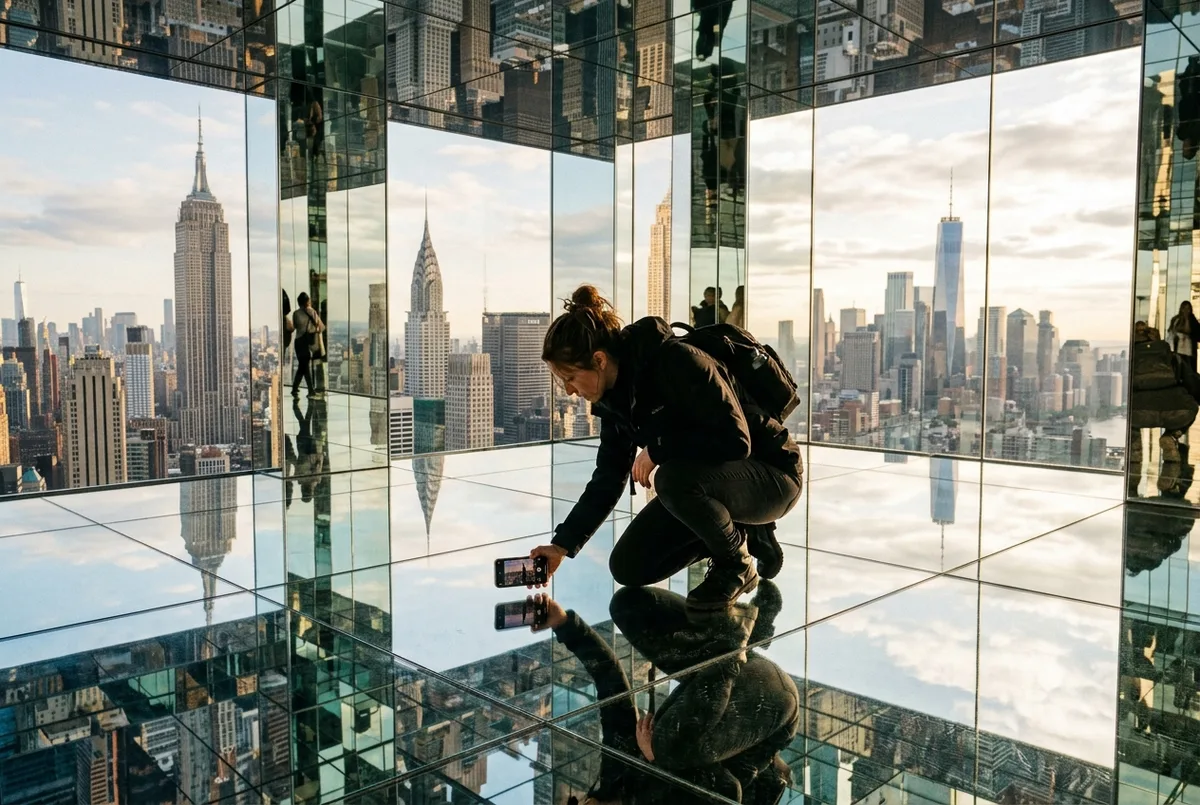
The best SUMMIT One Vanderbilt photos come from three places: the mirrored AIR rooms, the open-air terrace and the glass Levitation ledges. Each gives a different picture, and the trick is to use each for what it does well. Here is what I’d actually do: shoot the mirrors first while the light is strong, the terrace at golden hour, and the glass last.
This guide covers what each side of the skyline shows and how to handle glass and reflections. If you want the wider plan for the visit, my SUMMIT One Vanderbilt observation deck guide is the starting point.
Where are the best photo spots at SUMMIT One Vanderbilt?
The three that matter are AIR, the terrace and Levitation. AIR gives you reflections and abstract skyline shots. The 93rd-floor terrace gives you a clean, open view. Levitation gives you the “standing above the street” picture. The balloon room adds a soft, colourful background.
My pick for a single hero shot is the terrace at golden hour, since it needs no tricks. My pick for the most unusual shot is a low angle in AIR. I would skip trying to get all four in one hour, and accept that the mirrors and the terrace deserve most of your time.
What does each side of the skyline show?
You are in Midtown East, so the skyline shows familiar landmarks in a fresh arrangement. Look for the Empire State Building to the south and the Chrysler Building close by, as the tour listing points out. St. Patrick’s Cathedral and the Midtown grid appear from up high, and the Hudson River sits to the west.
I would think of it in four rough views:
- South. The Empire State Building is the anchor, and it is the one most people want in frame.
- Near, to the east and north. The Chrysler Building and nearby towers give you close, dense layers.
- West. The Midtown grid runs off toward the river, and it is best in warm evening light.
- The street below. Straight down, you see the traffic pattern around Grand Central.
Because the exact skyline angles depend on which window or terrace corner you stand at, I would walk the whole terrace once before you choose your spot. That saves you from queueing at the wrong window.
How do you photograph the AIR mirror rooms?
Go low. Hold your phone near your knees and tilt it up, so the reflections in the floor and walls stack together. The tour notes suggest photos from low angles, where reflections build up best, and that is my advice too.
Some tips that work in mirrored rooms:
- Shoot from the side, not straight on. Facing a mirror puts you and your phone in the picture.
- Use the floor. Reflections in the floor double the skyline and make the frame feel bigger.
- Keep the frame tidy. Other visitors are always in the background, so I’d wait a few seconds for a clean gap.
- Lower your screen brightness a little and wipe the lens, since smudges show up on glass and mirrors.
AIR is a two-floor installation by Kenzo Digital, and it is the most photographed space on the deck. I would give it at least 20 to 30 minutes, longer if photography is why you came.

How do you shoot through glass without reflections?
Press the lens close to the glass and cup your hand around it to block the room behind you. If you can, wear dark clothing, since bright clothes reflect in the window. Turn off the flash, because it bounces straight back into the frame.
Where there is a glass wall, I would find a spot where the interior lights are dim, and lean in with the lens almost touching. That kills most reflections. At night, this matters even more, because the room is brighter than the city outside. The terrace has no glass at all, so for a clean night skyline, I’d use it.
What camera settings work best?
Your phone is enough. Use the normal main lens for most shots, and tap the sky to set exposure so it does not blow out. Hold still for a second, use night mode when it is dark, and keep the horizon level.
If you carry a camera, I would keep it simple: a wide lens for the mirrored rooms and a standard zoom for the skyline. A tripod is unlikely to be practical in a busy space, so check the current rules on bags and equipment on the official site before you go. Small, easy-to-carry kit is my advice.
My bigger tip is to stop and look up from the screen. A skyline this big is better in real life, and the best pictures come after you have picked your view.
What is the best time of day for photos?
Sunset. You get warm light on the towers, then blue hour, then a lit-up city. Early weekday entries are the best choice if you want fewer people in frame. Midday gives the flattest light and the busiest rooms.
I’d rank them sunset, then early morning, then midday. If you are torn between day and night, my guide to SUMMIT One Vanderbilt at sunset and night explains how to choose the slot. For a more crowd-free visit, the early-access Grand Central combo starts before the day’s crowds, which the listing says makes the mirrored rooms easier to photograph. It costs more, and I would only pay for it in busy season.
Does the weather change your photos?
Yes, mainly through visibility. Clear skies give the sharpest long view. Haze softens the skyline, and fog can hide it. The mirrored rooms and the balloon room still photograph well in poor weather, since they do not depend on the view.
I would check the forecast a day ahead and look for clear or partly cloudy conditions. On a grey day, I’d lean into the art spaces and treat the skyline as a bonus. My SUMMIT One Vanderbilt weather guide explains how to read the forecast and decide whether to keep your date.
How do you photograph the glass ledges at Levitation?
Staff help with the queue and with photos at the ledges, so you can ask them to take your picture. The classic shot is looking down, or a friend shooting from a low angle. Empty your pockets first and use a wrist strap.
I would keep this quick. The queue moves, and lingering annoys the people behind you. Take a few frames, check them and step off. If you are nervous about heights, my advice is to shoot the ledge from the side, then decide whether to step onto it.
Which photo tips help most for couples and groups?
Ask a stranger for a photo in the mirrored room, and offer to swap. Use burst mode for jumping shots and hair in the wind. Take one wide group shot and a few close ones, since a group is hard to gather twice.
For a couple, I would use the terrace at sunset or the night lights. My date night planning guide covers the timing. For a group, I’d book an early slot so you have room to move.
What should you avoid when taking photos?
Do not use flash, do not block the queue at the ledges, and do not rely on one battery. Avoid leaving items on the floor while you frame a shot, and keep your bag small.
My rule is to take the shot and keep moving. A busy deck rewards people who are quick and polite. For more small habits like that, the SUMMIT One Vanderbilt tips list is worth a read.
Do you need a special ticket for good photos?
No. General admission covers all three floors, the installations, the Levitation skyboxes and the terrace, and it starts from about EUR 42 per person as of 2026-09-21. Prices may vary by date and slot. A skip-the-line guided option adds a guide and an online photo gallery, from EUR 141.
My view is that the standard ticket gives you all the spots you need, and the slot matters more than the tier. Book your SUMMIT One Vanderbilt ticket and choose a sunset or early slot to start. The guided option is only worth it if you want someone to show you angles and handle the pictures.
How does SUMMIT compare with other NYC decks for photos?
SUMMIT is built around mirrors and glass, which makes it very different from a plain window-and-railing deck. Its view also includes the Empire State Building and the Chrysler Building close by, which is a benefit you do not get from a deck that sits inside the skyline.
If you are weighing the options, my best observation deck in NYC guide compares the main ones. For the view itself, I would say SUMMIT is my pick for people who want photos with a bit of art in them.
My recommendation for SUMMIT One Vanderbilt photos
Book a sunset or early weekday slot, give AIR the most time and shoot the skyline from the terrace. Keep your phone secure at the glass, and clean your lens before you start.
For every product and its from-price, the SUMMIT One Vanderbilt home page has the list, and my glass floor and mirror rooms explainer covers what each space is. For background on the tower, see the One Vanderbilt article on Wikipedia.
FAQ
Can you take photos at SUMMIT One Vanderbilt?
Yes, photography is a big part of the visit. Check the official site for current rules on equipment such as tripods and larger bags.
What is the best spot for photos at SUMMIT One Vanderbilt?
The AIR mirror rooms for reflections, the terrace for a clean skyline, and the Levitation ledges for the glass shot.
What time is best for SUMMIT One Vanderbilt photos?
Sunset gives the warmest light and the night lights afterwards. Early weekday slots give fewer people in frame.
How do you avoid reflections in glass photos?
Press the lens against the glass, block the light with your hand and turn off the flash.
Is a photo package included in the ticket?
Not in general admission. A skip-the-line guided tour lists an online photo gallery, so check the booking page for what your ticket includes.